Showing posts with label Umar Sheikh. Show all posts
Showing posts with label Umar Sheikh. Show all posts
Thursday, 28 March 2013

Monday, 11 March 2013
EVALUATION - Question 1
All films that are produced start of with film openings, which follow conventions of film openings. As an audience, we are able to see title sequences and usually hear sound, whilst some sort of movement appear on the screen. These are aspects of the conventions that the audience is able to realise easily. However, there are more conventions that the openings follow that create effect but also to give the audience a brief idea of a location, character or plot. This is also known as the teaser to the story which is used to keep the opening continuous. Further effects can also be added to this to make the opening appealing.
The opening of a thriller film in particular also follows these conventions but the atmosphere created differ to other types of film genres. Most thriller films usually create a tense feeling, unlike a comedy film that would create a relaxed atmosphere. The scene itself may feel long in terms of what is happening, but in terms of duration compared to the rest of the film, it is very sort.
Main conventions of film openings :
 Narrative openings

The opening of a thriller film in particular also follows these conventions but the atmosphere created differ to other types of film genres. Most thriller films usually create a tense feeling, unlike a comedy film that would create a relaxed atmosphere. The scene itself may feel long in terms of what is happening, but in terms of duration compared to the rest of the film, it is very sort.
Main conventions of film openings :
- Teaser to the story - The teaser to the story is what makes the audience want to watch the film. It does not tell you what happens in the entire film, but it gives a them a preview that allows them to make guesses and decisions on what will happen next in the film. The teaser to the story can be created through the types of openings. There are two type of openings that are very good at giving teasers to the story.
 Narrative openings
It tells a part of the story, not giving away the entire plot but giving a preview. This should engage the audience, putting them in the actual atmosphere that is show on the screen from the start of he film, preparing them for what is upcoming. This is one of the best type of openings that gives a teaser to the story.

Discreet openings
This type of opening has a little relation to the film itself, but is a very effective way of giving a teaser to the story. Effects are used, but locations, characters and narrative are not given away to the story until after the opening. Sound may be used to replace the visual moving images. This is very effective because it puts the audience in an unaware position.
- Special effects - Atmosphere created through mis en scene. the mis en scene from effects are not the original video, but effects added on top of the original video to create a better visual scene. Even little effects, such as fades still help to create an understanding of what is happening but in an entertaining and skilful manner.
- Sound - The sound in a thriller film would be tense, taunting or have a sense of adrenaline. the sound would always have a relation to the scene. for example, a R&B song would unlikely be used in a horror thriller because it wouldn't match the sub genre. Special sounds can be used as well as special effects, such as heartbeat sounds, natural sounds etc.
- Title sequence - A title sequence would tend to follow an order according to the status of individuals in the hierarchy of the film. the sequence of titles will be briefly explained in the video beneath.
EVALUATION - Question 2
Representation is the portrayal or description of someone. people can be represented through stereotypes, just by simple things such as: Clothing, Ethnicity, Gender, social groups and much more.
The thriller that we chose was based around an action/crime sub genre. Therefore, the main social groups represented consist around a stereotypical male dominated group. There are three characters in the opening of the thriller, all from ethnic backgrounds. Ethnicity wasn't a stereotype that we used in the making of our film.
The thriller that we chose was based around an action/crime sub genre. Therefore, the main social groups represented consist around a stereotypical male dominated group. There are three characters in the opening of the thriller, all from ethnic backgrounds. Ethnicity wasn't a stereotype that we used in the making of our film.
- Crime boss/mob leader - between the ages of 25-35
The crime boss is shown to be the most powerful in the opening. He is equipped with a shirt and tie, not showing any parts of his body apart from the chin below. The mis en scene creates his status, as his limited appearance proves that he is worthy of holding a high status. When compared to the rest of the characters, We can see that his dress code is according to a middle class male, implying wealth and power. This is generally how a mob boss would tend to be seen, following the stereotypes of a working class male who has been associated in the crime life, making it from rock bottom to the highest peak.
He also gives a strong appearance not only through mis en scene, but also through sound. his voice is deeply toned, using simple vocabulary, to give away the crime sense. sophisticated language may have resulted in a softer disguise which would have taken away the hard on character that is being implied. We can hear the crime boss talk about taking away lives by giving his hit-man large sums of money, following the idea of contract killers and crime boss ideology. it also results in a violent lifestyle, surrounded by knife crime, gun crime and murder.
Although his screen time is the shortest, as an audience we are able to identify the social group that he represents as an individual. he represents a high status criminal, who would tend to have associates, people taking care of his finance, hit-men and more aspects a crime lord would have.
Looking at previous mob hit-men in the 1900's (Sicilian hit-men in America) such as Carlo Gambino, Tommy Luchesse etc, They all had similar things in common. Their dress code would be sophisticated but also strengthening their appearance as a Mafia boss. Money would usually be the main subject, revolving only around people who have wealth or access to wealth. Associates would be either family or close friends, keeping their social life restricted to only the people they can make a living out of. Settling down with a wife and kids are aims of some mob bosses, but not keeping them away from casino's, clubs and other similar forms of activities. women may be seen as the sensitive side of the person, someone that can help repair emotions and feelings. All of these aspects can be implied through less than a minute of screen time, due to previous stereotypes gathered from real life figures.
The mob leader is represented in a negative way as all the aspects of the stereotypical lifestyle contribute to this. However, in the crime world, mob bosses may be seen as role models, relating to the lifestyle that is lived. it generalises anti social behaviour.
- The hitman - between the ages of 20-27
The hitman is seen as a servant or slave to the crime boss. He is one who follows strict orders from higher ranks. The type of people he represents are unemployed men who do not have a source of income, resorting to crime and violence. however, a person like the hitman would show a person who proves that he is worthy of being payed for, by doing chores or jobs for members of one particular group. His ranks in the mob leadership is very low, meaning the lifestyle he lives is far more restricted than the lifestyle of the crimeboss, due to set boundaries. His wealth would not be very large, but enough to buy clothes, pay rent, eat and feed a family. therefore, his costume was urban based, containing a hoodedjacket, jeans and trainers. He represents a small scaled, discreet social group, as the things he would do for a living would be between himself, avoiding the law and sticking to the rules of the crime family he is involved in. In the past, this type of ranking structure was common, in America, England, Italy and Russia. mafia bosses were those who were capable of handling business. Most leaders started from the lowest ranks to the highest, and the ambition that the hitman shows are similar but in the modern day.
The outlaw occupation that he involves himself in represents a negative social group. the type of social group that is being formed are those that the media resent, such as gangs. Drugs, violence and money craving are things that people in similar social groups would feel the necessity to do and have. The aim of his role was to expose what people do or are forced to do. Negativity was not trying to be shown but was, due to the reality that surrounds us within society today.

- The victim - also between the ages of 25-35
The victim is the most important person when defining the social group he represents. he represents a group of victims, who suffer from abuse and violence. he portrays a strong person from a working class background who is a victim of criminals, with a past that could be almost traumatising. His character can represent various social groups within different ages.
He could represent a type of kid or teenager that does not have a happy social life, keeping their social life between social workers and family. although the character is shown to be an elderly male, his role in the film may imply that he may have had suffered a form of bullying in his younger years.
As he is shown to be elderly, he also represents elderly males in an urban area who suffer from poverty, engaging in criminal activities that backfire on them within the criminal society. the social group that he shows overall are negative but in a sympathetic sense. As a working class male, he may not have access to jobs in the urban area he lives in. Some victims of crime in real life are victims of criminals themselves because they engage in criminal activities that they cannot handle, just so that they can survive with food, shelter etc.
the final social group he could represent are former gang members (dropouts). this can be viewed upon positively, as his attraction to crime is now repelling towards a legit life, although he has to carry out crimes to to clear obstructions to live a peaceful life.

EVALUATION - Question 4
Thriller films have a large audience, but it is dominated by males in particular. This is because most thriller films have aspects that do not suit the entertainment of females, such as action and violence. However, the thriller genre is an umbrella to many thriller sub-genres that can differ in terms of its audience in general.
Supernatural /Horror films are one of the type that have a varied audience. It does not have aspects that are norms of values of either males or females, but the the entertainment is occasional, as the jumpy and scary atmosphere that they give of do not suit daily lives or hobbies. It would usually be dark, with a paranormal activity going on in the Mis-en-scene. The sound will vary from low sounds to instant loud sounds, to give a unusual reaction to the audience. These types of films are usually viewed by couples or more than 3 people in one group, as most audiences may not feel comfortable watching them on their own. the age range would be aimed at roughly 15-35. This can be a reason why the audience is mixed as the age range also levels out its target audience to give similar numbers from each gender.
The category that matched our thriller opening was Crime/Action thriller.
Our thriller opening, 'Bloodline' suited best in this particular category due to the images and ideas given through Mis-en-scene, sound, camera work and editing to the audience. At the very start of our thriller opening, we hear a plot to murder another person, instantly giving the crime/action feeling. However, at the very end of the opening, the murder plot is turned around when the killer is killed by the victim. This automatically draws in a sense of action and crime, knowing that it will lead to a series of Crime/Action event throughout the rest of the movie. A fixed audience is gathered through this basic information, as it implies that the target audience is between teenagers (16+) to adults (30-40). Crime is a type of sub-genre that has precautions as to exactly the message that would be given of to the audience, which means that the audience would not be younger than 16, or any age that can be influenced negatively through this type of media entertainment. Feedback during the process and after the process of filming were 90% male. The title and story line engaged a wider male audience rather than a female audience, which was the expected turn out.
Examples of some thriller sub genres:
- Romance thriller
This type of thriller is one of which that holds a vast majority of female audiences. romance is a type of genre that females may be able to relate to through emotion and feeling. action and violence are limited, as the key aspects are usually to do with love, hate, sadness and happiness. This is one of the few sub-genres that male audiences may not participate in, although male characters might take part in the film.
A famous film in this category that has had a large number of female reviews is 'An Education'.
A famous film in this category that has had a large number of female reviews is 'An Education'.
 |
| The reviews on YouTube of this film are positive from a one sided female audience. |
- Action thrillers
Action thrillers are known to be one of the most male dominated out of all in the thriller sub-genre. They tend to have a hero, a villain because the story lines usually have plots to do with saviour and revenge. The colours on the screen are mostly dark to create a strong, gloomy atmosphere (Mis-en-scene). Sounds are loud with changes of speed and tone to create excitement, engaging the audience to the mi-en-scene. The camera work would also change in a matter of quick shots to keep up the pace of the action in the plot. All of these technologies have similar contents that an action game on a console would have, such as Call of Duty. This can be a reason why the audience is male dominated, as it relates to day to day hobbies, interests and entertainment that a male teenager or adult could resort to. very young male kids watch cartoons such as action man, power rangers and many more as they get older. television and internet are two sources of technology that allow all ranges of age groups to access their favourite movies and clips which boys, teenagers and men are accessible to. A lot of action films such as Batman also have used synergy to create console products, such as games on Ps3 to bring in a larger male dominated audience of nearly all ages, but aimed at an audience from 15+.
 |
| The comments on the Facebook page of Batman are packed with a male audience from different countries as it is global. |
A famous film in the action thriller sub-genre that has had a large number of reviews from males is Batman: The Dark Knight
- Supernatural/Horror Thrillers
Supernatural /Horror films are one of the type that have a varied audience. It does not have aspects that are norms of values of either males or females, but the the entertainment is occasional, as the jumpy and scary atmosphere that they give of do not suit daily lives or hobbies. It would usually be dark, with a paranormal activity going on in the Mis-en-scene. The sound will vary from low sounds to instant loud sounds, to give a unusual reaction to the audience. These types of films are usually viewed by couples or more than 3 people in one group, as most audiences may not feel comfortable watching them on their own. the age range would be aimed at roughly 15-35. This can be a reason why the audience is mixed as the age range also levels out its target audience to give similar numbers from each gender.
 |
| Vary of males and female comments and reviews on the Paranormal Activity Facebook page. |
A lot of supernatural/horror thrillers, such as 'The Exorcism of Emily rose', are based on real life events, containing a source of religion to resolve the mysteries. There are many negative views on films like these, as real life horror events along with religion are publicised as entertainment, not considering some ethical and religious views. this can cut out a huge amount of the audience as it could reduce due to unwanted scenery.
A good example of a supernatural thriller with a wide ranged audience
is Paranormal Activity
The category that matched our thriller opening was Crime/Action thriller.
Our thriller opening, 'Bloodline' suited best in this particular category due to the images and ideas given through Mis-en-scene, sound, camera work and editing to the audience. At the very start of our thriller opening, we hear a plot to murder another person, instantly giving the crime/action feeling. However, at the very end of the opening, the murder plot is turned around when the killer is killed by the victim. This automatically draws in a sense of action and crime, knowing that it will lead to a series of Crime/Action event throughout the rest of the movie. A fixed audience is gathered through this basic information, as it implies that the target audience is between teenagers (16+) to adults (30-40). Crime is a type of sub-genre that has precautions as to exactly the message that would be given of to the audience, which means that the audience would not be younger than 16, or any age that can be influenced negatively through this type of media entertainment. Feedback during the process and after the process of filming were 90% male. The title and story line engaged a wider male audience rather than a female audience, which was the expected turn out.
 |
| The FaceBook page was successful in retrieving followers. Pictures and videos were uploaded for positive and negative feedback |
EVALUATION - Question 5
As a whole, all the aspects of our opening attract a male dominated audience.
However, what are the aspects that attract this audience?

To start of with, interpretations can be gathered simply from the title. Bloodline is a word that holds a sense of danger, as the word blood suggests anger, love, hatred and revenge. At first sight, a female would not be drawn towards the title as much as a male would. Whilst choosing the name of the title, we asked male and female audiences as to their view on the title name. More positive feedback came from the male audience rather than the female audience.
 Mis-en-scene - The mis-en-scene is one aspect that attracts the target audience. For example, what we see as an audience is someone being followed. It is continuous throughout almost the whole opening. The vulnerable atmosphere that it creates gives implications of a male audience, which was our target.
 Actors - The actors are strong, tall and hard on characters. There are three males, all containing negative and mysterious appearances. From the crime boss (highest power) to the victim (lowest power), we were able to range the the statuses of the characters so that the film is not biased in the sense of its actual storyline. (crime based). the majority of male actors mean that the audience would also have majority of males, relating to the attitudes and values that a teenager or adult would have.
Storyline - The story line is quite complex, especially in the opening of the film. In the opening, the contract killer is killed by the person who he was meant to kill. This twist engages the audience because action and crime start from the beginning of the film, giving a sense that the rest of the story line will hold similar situations. Crime thrillers and action thrillers consist of a large male audience. The story line uses these type of functions to create a story line that would attract this audience from the very beginning of the film.
Genre and Location - The crime/action thriller genre is known to have a wide male audience from various ages. however, some crime/action films, such as Scarface are films that have a global audiences. Our film opening differs, as an urban location changes the way audiences would think about the film, due to the reality it brings. Films like Scarface are legendary films in the genre, but our production are on similar levels as productions such as top boy which had a large audience within urban communities.
Sound - The sound is loud, mixed with natural sounds and a drum bass musical. The types of sounds are similar to the sounds that most thrillers have which is taunting. The Foley sound of gun shots are also loud, as the music and heartbeat Foley sound all lead up to the shooting moment. This takes away a huge number of the female audience, but engaging a large number of male audiences as the thrilling sound suggests a sense of action and crime through the atmosphere given.
When we started of or editing for our production, we made a rough cut so we were able to show our intended audience what they will see from our opening. We got feedback before the final cut, so as a group we could gain more ideas as to what the audience would want to see and hear. Negative feedback was intended from the audience so we could use the criticisms to create a better, sharper video through our editing.
When we viewed the rough cut to our audience, we got a lot of negative feedback as well as positive feed back. For example, the positive feedback was commonly based around the mis-en-scene (a person being followed). However, negative feedback consisted around the editing and camera work. Most editing, such as cuts from one scene to another were changed after the feedback because they were either too long or too short. Also, some shots were blurred or were taken wrong, meaning that we had to travel back to our location to improve these things.
To reach our audience with our final production, we had to release our film opening. it was released in the cinema were there was a large number in the audience. They may have seen our promotion on our Bloodline FaceBook page, were previews and pictures of our production were posted. After the release in the cinema, it was put onto Youtube and Vimeo, two networks that allowed us to upload the video for free. With our low budget, DVD and Blu-ray could not be used for our film, so online networking were the easiest and cheapest way to promote out video.
interview from a member from the teenage male audience
interview from a member of the teenage male
audience
interview from a female audience member
to get feedback and a non-biased response
EVALUATION - Question 6

These are technologies that we used to construct our film opeing.
The main technologies used were the macs and the cameras, as they allowed us to film and edit.
FinalCut Pro combined with SoundTrack Pro
Final cut pro is where we imported our clips so that we can edit them in terms of effects, length cuts, match cuts and much more. This helped us prove our skills as to camera work and editing in terms of Mis-en-scene. After we put the videos in a fixed order, we imported the video into soundtrack pro, which allowed us to make Foley sounds, music and other sounds that matched the editing to make normal effects combine with sound effects and music to flow with the Mis-en-scene. From sound track pro, we could put the sounds that we created in order as one track, so that we can add it to the FinalCut Pro where the two (sound and movement) would work together as one basic video.
 |
| Importing videos videos and sound onto FinalCut pro |
.jpg) |
| FinalCut Pro |
 |
| SoundTrack Pro |
Memory Cards, USB, Macs and Hard Drive
To save all our work, we stored it on our Hard Drive so that it did not get lost or mishandled. to get them From the Memory Card to The hard Drive, we needed to connect the memory card to a USB which then was connected the the Macs. This allowed us to view our work and choose what files were needed to keep and what ones were not. Without this process, our work may have been at risk of being deleted or getting lost. It also kept us organised and well prepared, as we knew that if anything got deleted on the macs, the Hard drive would back be a source of back up.

.jpg)
Blogger and all of our production and pre production
Blogger allowed us to keep upto date with what we were doing. for example, when we started of our thriller opening project, we first did a planning on our story boards, locations, plot, characters etc. Blogger helped us as a group as well as individually, as our ideas, planning and process throughout the making were all put onto one Blog were the group could access everything we were doing, starting from planning the production to the end of the production. All our work was safe here and all accessible on one page. Blogs were also allowed to be tagged by more than one member of the group, making it easier to get larger amounts of work done by more than one person without only crediting an individual.
 |
| Our blog posts were we can edit and view them |
 |
| The actual Blog page were all of our work is presented. |
EVALUATION - Question 7
Preliminary Film
Looking back at the preliminary film that we produced earlier on in the year, members of our group gradually gained skills to help us create a better production for our thriller opening since then. this includes skills with the cameras, skills with editing and using softwares o the Macs, getting used to equipment and much more.
Story board for our preliminary project.
The story board for this project was created with still pictures using a still camera. This helped us to get used to the one of the technologies that we wold be using throughout the thriller opening project. Using the cameras, we were able to identify the 180degree rule, a key rule used in camera work to help the audience understand the mis-en-scene. we also identified shots that were good and shots that were faulty. some examples of this were close up shots, medium shots and other types of shots that we as a group were new to.
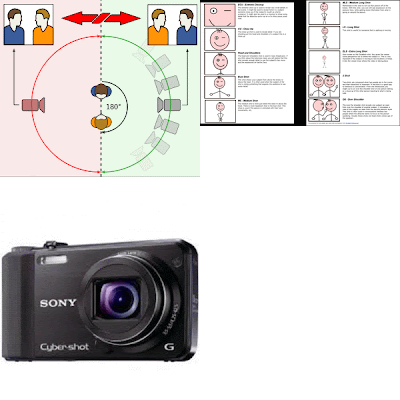
When we filmed the prelim, lighting problems caused the mis-en-scene to be unclear, showing unnecessary light in the mis-en-scene. This was something that we became aware of, as natural light directing towards the camera changed the atmosphere of the message that the prelim was trying to come across. therefore we were able to realise that key things that are shown could change an atmosphere, such as bright light in a police station. we can see this in the first shot in the storyboard above, where Javayl is walking down a corridor with a direst light ahead.This is not something that would be seen because most police stations have tinted windows with an office based structure.
Camera use
When we used the JVC cameras, it was one of he first time that we could practice using it. Some things that we learned about the camera through our prelim
Looking back at the preliminary film that we produced earlier on in the year, members of our group gradually gained skills to help us create a better production for our thriller opening since then. this includes skills with the cameras, skills with editing and using softwares o the Macs, getting used to equipment and much more.
Story board for our preliminary project.
The story board for this project was created with still pictures using a still camera. This helped us to get used to the one of the technologies that we wold be using throughout the thriller opening project. Using the cameras, we were able to identify the 180degree rule, a key rule used in camera work to help the audience understand the mis-en-scene. we also identified shots that were good and shots that were faulty. some examples of this were close up shots, medium shots and other types of shots that we as a group were new to.
 |
| Prelim Storyboard |

When we filmed the prelim, lighting problems caused the mis-en-scene to be unclear, showing unnecessary light in the mis-en-scene. This was something that we became aware of, as natural light directing towards the camera changed the atmosphere of the message that the prelim was trying to come across. therefore we were able to realise that key things that are shown could change an atmosphere, such as bright light in a police station. we can see this in the first shot in the storyboard above, where Javayl is walking down a corridor with a direst light ahead.This is not something that would be seen because most police stations have tinted windows with an office based structure.
Camera use
When we used the JVC cameras, it was one of he first time that we could practice using it. Some things that we learned about the camera through our prelim
- How to insert, eject and use memory cards
- How to turn on and turn off the cameras.
- How to use the camera with extra equipment, such as LED lights, tripods
- How to handle the cameras without damaging them
Getting used to the FinalCut Pro software.
Before this prelim exercise, final cut pro was not a familiar programme to the group. Through the exercise, we were able to play around with the programme to get used to it and understand the way it can be used in depth. what we learned in FinalCut Pro through this exercise:
- how to insert video
- how to create a single video using more than one clip
- how to edit videos using transitions and fades
- how to cut and match cut.
The Thriller Project
Friday, 8 March 2013


EDITING - CHANGES & OPTIONS
CHANGES AND OPTIONS (during editing)
TITLES
During the filming we had to decide on the titles and if we are sticking to the same style at first we decided to do on screen titles and then wanted titles on a black screen. However we realised out filming and scenes where too much of a time waste because we had to keep it as an OPENING and try not to drag it on too much. so doing titles on a black screen would make it longer and over the limit of a 2minute opening which is our aim.
SOUND
We searched for different sounds and music for most part of our film however this took alot of time because we didnt really consider the music and sounds at first we knew the foley sounds but not the actual music so this took up loads of time than nessasary to find however the end result we found suitable sounds and mixed it in "SOUNDTRACK".
* These are the two main problems we had on the editing stage while trying to rush into it too much. but after putting it all together we think that we finally achieved a good and satisfying edit that we was proud of. We added the effects - motions and transactions and we think its going well so far.
FILMING - SHOOT 2
| This is the Location we filmed at: The Barbican centre. We wanted an urban scenery that has a little bit of mysery along with it and so we chose this mostly for the fact there are so many ways in which we can take different shots of a follwoing scene. |

 |
| This is where we shot the scene where i am being followed down the stairs and we realised we had to put the camera at a low angle by moving the tripod to its lowest by using the handles. |
 |
| This is where we check all shots for focus, angle and the way the scene is set and we must consider the mise en scene and lighting to make sure it flows throughout all our clips this is why we had to make sure that we try to film all of the scenes in one day to get the timing right and create a realistic feel. |
 |
| This is the scene where we decide to take a high angle shot of me walking and the follower/hitman is watching me and making decisions on where my next move is... this is when it slightly goes wrong because right here he is behind me a bit more than the beginning so the last shot tells the timing that he is late and lost track of the victim. |
 | |||||||||||
| this picture illustrates the fact it was windy and cold and we had to try set up equipment where there was no wind because even our hands got a bit too cold to handle the equipment. we learned that we had to be quick because the second time we done it we were running behind on time. also had to re-shoot all the scenes again. explained below. |
* SHOOT 2 was where we had to re-do all the scenes because the main characters was injured at home so 'Emadul' had to step in and play the part of the person being followed. Even though we had to re-do everything we were more confident in this because we knew what shots we needed and had a rough idea of what we needed to do to make the shots more better... including making sure the camera is level and isnt really shakey when we had to do tracking and in this new shoot we rememberd to have a variety of shots.
[[[[[ SHOOT 2 ]]]]]
Thursday, 7 March 2013
Planning - Locations
As a group we did decide that the main idea was of a man being followed from one area to another. Settings and locations will need to be suitable for this, meaning open areas need to be available as well as closed up areas, to balance out the suspense and to keep it realistic. the Barbican was the best recommendation due to the widely surrounded area that contains stairs cases, building, rugged walls, pillars and much more. Also, the Barbican station gave us an idea on where to start the following process, taking the scenes from a crowded area towards a less compact area. we think that this can be effective as the audience will feel like they are in a maze. the Location is shown beneath.
.jpg) |
| A birds eye view of the Barbican |
 |
| Deep inside the Barbican |
 |
| The station |
HOLIDAY RESEARCH 1 - Analaysing An Education
http://www.artofthetitle.com/title/an-education/#
The link above will direct you to the film opening that I have analysed.
The opening of this film goes by the stylised type opening. this is because the effects that are used consume most of the opening screen time on a black screen, where the titles appear over the effects but also on the black screen.
Mis en Scene
After the effects using the black background, acts appear where students are walking with books balanced on their heads. its is a female dominated film, because the students and teachers are females. Not a single male is portrayed, which means that the audience is aimed at females due to their relating situations that they are or have been in. The school uniform implies that the school is strict and this can be further supported by what the girls are doing (balancing books n their heads). As the audience we know that they are not doing it on purpose, but have been told by the stereotypical harsh female teacher. we also see the girls cooking, which a also a stereotypical role of a female.
Sound
The music is a piano melody, relaxing and calmly entertaining, without any sense of suspense or mystery. it plays through out the whole opening, as the pitch gets higher and lower throughout to make it engaging instead of not entertaining the audience.
Camera
There are various types of camera work that have been used in this opening. The first 40-50 seconds do not involve any camea work, but starts after that using a mid/long shot.
Panning is used from the bottom of the students and teachers bodies, panning up as they dance to keep a speed going without long intervals.
Close up shots of students, cooking equipment and more are used to show specific things that are happening, such as cooking, looking through the window etc.
Editing
The first 40-50seconds consist of editing of animations, titles on the black screen etc. however, after the black screen, titles are also used over the actual camera video, continuing the animated effects. Match cuts are used sometimes, but the most effective effects are the fades and transitions. The fades occur whilst the camera is panning, collecting visual information of what is happening then moving towards an opaque object which allows the fade to work successfully to link different timings.

Titles on black screen
BBC Film Presents
A Finola Dwyer Production/Wildgaze Films production
In Association with Endgame Entertainment
A film by Lone Scherfig
Actors -Peter Sarsgard, Alfred Molina, Rosamund Pike, Dominic Cooper, Olivia Williams, Cara Seymour, Sally Hawkins etc
Title - An Education
The link above will direct you to the film opening that I have analysed.
The opening of this film goes by the stylised type opening. this is because the effects that are used consume most of the opening screen time on a black screen, where the titles appear over the effects but also on the black screen.
Mis en Scene
After the effects using the black background, acts appear where students are walking with books balanced on their heads. its is a female dominated film, because the students and teachers are females. Not a single male is portrayed, which means that the audience is aimed at females due to their relating situations that they are or have been in. The school uniform implies that the school is strict and this can be further supported by what the girls are doing (balancing books n their heads). As the audience we know that they are not doing it on purpose, but have been told by the stereotypical harsh female teacher. we also see the girls cooking, which a also a stereotypical role of a female.
Sound
The music is a piano melody, relaxing and calmly entertaining, without any sense of suspense or mystery. it plays through out the whole opening, as the pitch gets higher and lower throughout to make it engaging instead of not entertaining the audience.
Camera
There are various types of camera work that have been used in this opening. The first 40-50 seconds do not involve any camea work, but starts after that using a mid/long shot.
Panning is used from the bottom of the students and teachers bodies, panning up as they dance to keep a speed going without long intervals.
Close up shots of students, cooking equipment and more are used to show specific things that are happening, such as cooking, looking through the window etc.
Editing
The first 40-50seconds consist of editing of animations, titles on the black screen etc. however, after the black screen, titles are also used over the actual camera video, continuing the animated effects. Match cuts are used sometimes, but the most effective effects are the fades and transitions. The fades occur whilst the camera is panning, collecting visual information of what is happening then moving towards an opaque object which allows the fade to work successfully to link different timings.
Titles on black screen
BBC Film Presents
A Finola Dwyer Production/Wildgaze Films production
In Association with Endgame Entertainment
A film by Lone Scherfig
Actors -Peter Sarsgard, Alfred Molina, Rosamund Pike, Dominic Cooper, Olivia Williams, Cara Seymour, Sally Hawkins etc
Title - An Education
RESEARCH - Previous student openings
http://vimeo.com/17216336#
The link above will direct you to the film opening i have analysed, by Jack Simpson, Luke Nightingale, Bilal Salli and Onur Kavruk
Sound
Starting of from the sound when the Ident appears, the sense of a sharp, restless atmosphere begins. The sound changes as the film opening starts, but the same atmosphere is given through sound as we hear a rather suspense soundtrack that matches the actor who is running. A heartbeat is then sounded, automatically gaining the viewers attention, giving them a slight brief but incomplete idea of what happens next. Natural sound is then produced, mixing with the heartbeat to give a realistic feeling.
Editing
Fades and Transitions have been used throughout, to connect one scene to another timing without having to show what happens in between. This keeps the opening consistent.
Mis En Scene
A man is running away in a forest near a lake, wearing smart but rough clothes with a brief case. We can clearly see that the actor is portrayed as an older male, running away from someone, due to confidential information which he possesses.
A computer screen is also shown, giving misleads to what is happening in the forest, as well as implying a connection between the two locations.
Camera Work
a variety of camera shots and angles have been used. for example, close up shots have been used, long shots have been used and also mid shots. A very effective shot used is the low angle shot, where we can see the main characters feet, upwards along with his whole body. They have also used panning shots and tracking shots, which help to create more than one visual appearance, making the audience feel uneasy.
The link above will direct you to the film opening i have analysed, by Jack Simpson, Luke Nightingale, Bilal Salli and Onur Kavruk
Sound
Starting of from the sound when the Ident appears, the sense of a sharp, restless atmosphere begins. The sound changes as the film opening starts, but the same atmosphere is given through sound as we hear a rather suspense soundtrack that matches the actor who is running. A heartbeat is then sounded, automatically gaining the viewers attention, giving them a slight brief but incomplete idea of what happens next. Natural sound is then produced, mixing with the heartbeat to give a realistic feeling.
Editing
Fades and Transitions have been used throughout, to connect one scene to another timing without having to show what happens in between. This keeps the opening consistent.
Mis En Scene
A man is running away in a forest near a lake, wearing smart but rough clothes with a brief case. We can clearly see that the actor is portrayed as an older male, running away from someone, due to confidential information which he possesses.
A computer screen is also shown, giving misleads to what is happening in the forest, as well as implying a connection between the two locations.
Camera Work
a variety of camera shots and angles have been used. for example, close up shots have been used, long shots have been used and also mid shots. A very effective shot used is the low angle shot, where we can see the main characters feet, upwards along with his whole body. They have also used panning shots and tracking shots, which help to create more than one visual appearance, making the audience feel uneasy.
Research - Timeline
All film openings consist of titles that are placed in a strict order, according to the importance of the person, company etc. The most contributed is usually put in first, continuing to the last title in the order of importance.
In conventional film openings:
1. The production company
2. A second production company (if there is one)
3. The distribution company
4. The title of the film
5. The actors, starting of from the main actor/actress.
(Successful actors/actresses may appear before the film title, depending on their status in the film industry)
6. The rest of the actors will then be placed after another.
7. The crew, including costume designers, casting, music producers, executive producers and more.
8. The writer and then the producer/director.
1. New line Cinema Production
2. An Arnold Kapleson Production
3. A film by David Fincher
4. Brad Pitt (appears before the film title due to Hollywood status)
5. Morgan Freeman (also appears before the title)
6. Se7en - film title
7. The rest of the Actors/Actresses
8. Casting crew - Billy Hopkins, Suzanne Smith and Kerry Borden
9. Music by Howard Shore
10. Costume Designer - Michel Kaplan
11. Edited by Richard Francis Bruce
12. Production Designer
13. Director of Photography
14. Co Producers
15. Co executive producers
16. Executive Producers
17. Written by Andrew Kevin Walker
Although the film opening uses a lot of effects, the film has followed the conventions of the film opening title sequence.
In conventional film openings:
1. The production company
2. A second production company (if there is one)
3. The distribution company
4. The title of the film
5. The actors, starting of from the main actor/actress.
(Successful actors/actresses may appear before the film title, depending on their status in the film industry)
6. The rest of the actors will then be placed after another.
7. The crew, including costume designers, casting, music producers, executive producers and more.
8. The writer and then the producer/director.
1. New line Cinema Production
2. An Arnold Kapleson Production
3. A film by David Fincher
4. Brad Pitt (appears before the film title due to Hollywood status)
5. Morgan Freeman (also appears before the title)
6. Se7en - film title
7. The rest of the Actors/Actresses
8. Casting crew - Billy Hopkins, Suzanne Smith and Kerry Borden
9. Music by Howard Shore
10. Costume Designer - Michel Kaplan
11. Edited by Richard Francis Bruce
12. Production Designer
13. Director of Photography
14. Co Producers
15. Co executive producers
16. Executive Producers
17. Written by Andrew Kevin Walker
Although the film opening uses a lot of effects, the film has followed the conventions of the film opening title sequence.
Monday, 4 March 2013
FILMING - Behind the Scenes (SHOOT1)
With our story board, plot and ideas put together, our group were now able to start setting up filming in the barbican (the main location). The weather was fine according to the plan. The pictures shown beneath are behind the scenes, starting from the collection of equipment to the located spot where we processed our filming.
 |
| Picking up equipment The equipment we used were picked up from the media department. The lighting equipment is one of which were used, as well as cameras, tripods and the camera itself that pictures were taken with. This picture was taken in the classroom before we set of for our journey to the barbican. |
 |
| The bus journey from angel to the barbican. Although there was traffic that consumed a bit of time, we were still able to make it to the barbican at the time we planned to reach the destination, as we left earlier to avoid the traffic from cutting valuable time. Equipment was put in the luggage section to prevent damage. |
 |
| Reaching the Barbican and setting up the first shots. We reached the location (Barbican Station). the first shots began from just outside the station, as the picture shows people going in and out of the entrance. Our group was aware of the amount of people that would be in the area, so we had to be sure that we used the equipment in the safest place to avoid any collision of equipment and actors. |
 |
| This picture was taken at the same spot. We discussed exactly how we will take the shots including angles, to perfect how and what would be seen on the screen. |
 |
| Moving up through the barbican. After the first couple shots were complete, we moved from outside the station, up the stairs of the station and to the long bridge pathway as shown below. The pathway was empty at the time of filming, giving us a better chance to use more space around us. the picture shows members of the group once again discussing how we could use the space and what shots would be used. |
 |
| Once we discussed our plan for shot types in this location, we set of filming. the two main characters are shown in the picture, one behind another, carrying out the routine of someone being followed. |
 |
| deeper in the barbican, this picture was taken of Emadul in the filming process. Here he is shown doing the camera work. |
The first shooting got the group familiar with the area and gained more confidence the group as to what we were doing. More filming was done, but as a group we decided that we would have to make another journey to the barbican to complete the filming and to retake a few faulty shots.
Subscribe to:
Posts (Atom)